

At a glance
QUT is hiring a Senior Tech Officer (BMS) at $138,193 to $156,633 total package. See the skills, selection criteria and how to apply by 10 Nov 2026.

Queensland University of Technology is hiring a Senior Tech Officer (BMS) to run the building management systems that heat, cool, meter and monitor its two main Brisbane campuses. The figure most licensed tradespeople will check first is the package: $138,193 to $156,633 a year at HEW8, made up of a base salary of $116,774 to $132,357 plus 17 per cent superannuation and 17.5 per cent leave loading. The role is ongoing and full-time, sits in Facilities Management within the Administrative Division, and closes on 10 November 2026 at 11.30pm.
A building management system — BMS — is the control layer that lets a large building run itself: chillers staging on and off, air handling units responding to occupancy, lighting and blinds reacting to daylight, meters logging every kilowatt-hour. At a university the size of QUT, that layer has to hold while lecture theatres fill and empty on a timetable and research labs demand stable conditions around the clock.
What the role actually involves
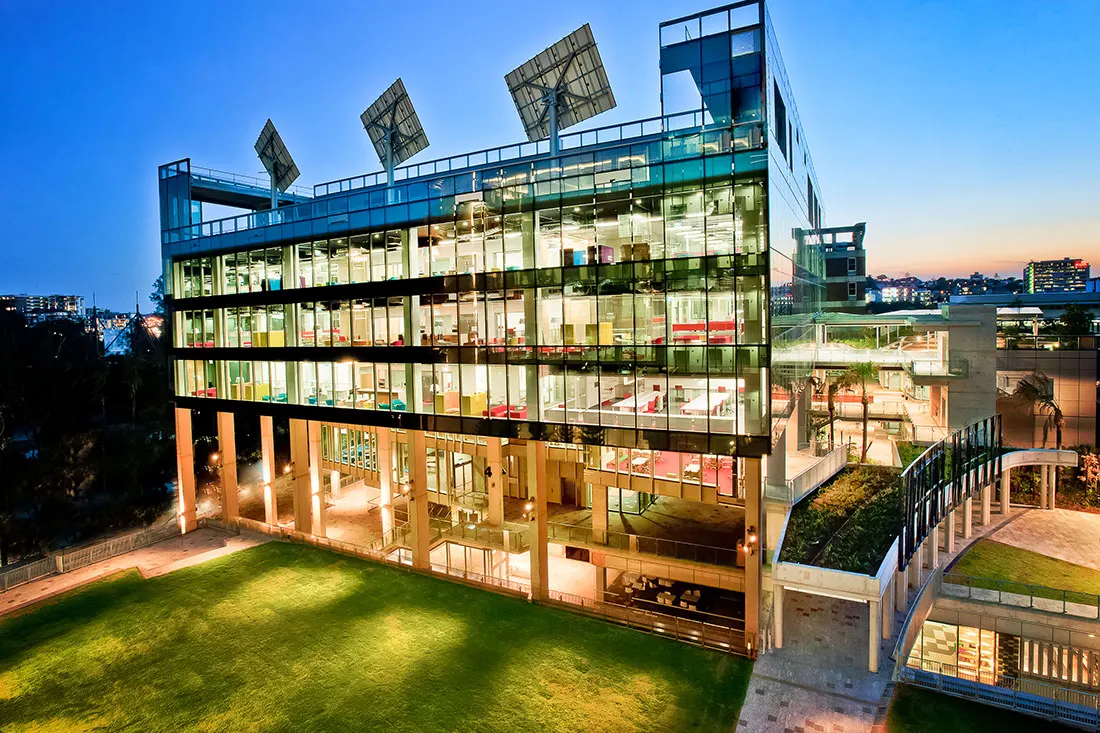
QUT runs two main campuses. Gardens Point has 28 buildings across 7.3 hectares beside the Brisbane River; Kelvin Grove has 41 buildings on a 20-hectare site, with a further 17 buildings off campus. Around 50,000 students and 12,000 staff move through those spaces, and the estate is deliberately open to the public. The BMS is the quiet infrastructure underneath all of it.
The position description splits the work into three strands. Day to day, you operate, develop, upgrade and expand the university's BMS and related building services technology, including energy metering and automated blind control. On new builds and refurbishments, you contribute to commissioning so the control systems are handed over working, not merely installed. And you manage minor works and deferred maintenance projects, mostly BMS infrastructure but occasionally touching HVAC and fire systems. You'll work with the Operations, Capital Works and Major Projects teams, alongside external contractors, and there are reasonable overtime and on-call arrangements at overtime rates under the Enterprise Agreement for professional staff.
The pay, measured against the private market
Here's the base rate worth knowing before you romanticise the title. In Australia, a BMS technician's base pay typically lands between about $87,000 and $98,000 a year, with total pay averaging around $111,000 once extras are included, according to Glassdoor's BMS Technician salary data. Private-sector BMS service technician ads in Brisbane and Melbourne commonly sit at $90,000 to $120,000 base plus super and a vehicle.
The QUT role is the exception above that band. At HEW8, the base is $116,774 to $132,357, and with 17 per cent super and 17.5 per cent leave loading the total package runs $138,193 to $156,633. That's a senior post: you're expected to interrogate systems, supervise contractors, mentor colleagues and carry project delivery, not just answer alarms.
The skill bar is specific
The selection criteria are a checklist you should read line by line. You need an electrical trade qualification and a current electrical licence, backed by extensive building services trades experience. You need demonstrated hands-on competence in interrogating and operating Schneider building management systems, and in fault-finding when they go wrong — the posting names INET and VISTA, plus StruxureWare — or equivalent platforms such as Johnson Controls or Siemens. Schneider has been folding its StruxureWare Building Operation software under the EcoStruxure Building name, so don't let the rebranding throw you; the underlying controllers and graphics are what the panel cares about.
Beyond the platform work, you'll need extensive knowledge of building engineering services design, particularly chilled water systems, plus building management control and metering. There's a project management requirement: stakeholder engagement, procurement, financial management and high-quality documentation. You'll need working knowledge of Queensland Workplace Health and Safety legislation, and a record of guiding contractors on site and mentoring colleagues. A commitment to equity, diversity and Indigenous Australian engagement rounds out the list.
Why this has quietly become a decarbonisation job
A controls technician I worked alongside — call him Pete — inherited a campus BMS where the on-screen graphics still showed a chiller that had been replaced three years earlier. The software ran; the documentation didn't. His first six weeks went into tracing plant and redrawing the front end, not tuning it. Multiply that by 41 buildings and you can see why QUT lists commissioning and high-quality documentation as core duties rather than nice-to-haves.
The reason it matters now is written in QUT's carbon numbers. The university's revised Carbon Strategy aims for net zero across scopes 1, 2 and 3 by 2049, with gross scope 1 and 2 emissions cut 50 per cent by 2025 from a 2018 baseline and 70 per cent by 2030 on the way to 95 per cent by 2035. The 2024 Sustainability Action Plan Progress Report puts reportable scope 1 and 2 emissions at 26,691 tonnes of CO2-equivalent, down 38 per cent from the 2018 baseline of roughly 42,000 tonnes, with energy intensity at 0.47 gigajoules per square metre — 17 per cent below baseline. The BMS is the instrument that produces those reductions: scheduling, setback, fault alarms and metering are where a campus actually saves energy rather than announcing it.
What this means for your application
Two filters will remove most applicants before an interview. First, the electrical licence: this is a hands-on trade role, and the posting asks for evidence of the qualification and current licence together with building services experience. Second, platform depth: if your CV says "familiar with BMS" but doesn't name the systems you've configured or fault-found, that's a gap. Name the platforms — INET, VISTA, StruxureWare, EcoStruxure, Johnson Controls, Siemens — and the buildings or plants you've commissioned.
There's no visa sponsorship, so you need ongoing full-time work rights in Australia. QUT also states plainly that Aboriginal Australians and Torres Strait Islander people are encouraged to apply. And because this is an ongoing HEW8 role, expect a selection-criteria process: answer each criterion with a concrete example, and put the strongest one against the Schneider platform requirement.
What's on offer, and the next step
The extras in the package are where university employment conditions differ from a private controls contractor:
- Up to 17 per cent superannuation and 17.5 per cent leave loading
- Primary carer parental leave of up to 26 weeks, including 17 per cent super
- A Purchased Leave Scheme of up to eight extra weeks a year
- Salary packaging for superannuation, vehicle leasing and on-campus services including childcare and parking
- Fitness Passport and discounted private health insurance
Applications open 27 October 2026 and close 10 November 2026 at 11.30pm. Submit through the QUT application portal, and the position details are also on the AcademicJobs listing. Before you open the form, download the position description and draft your answer to the Schneider platform criterion — list the systems you've worked on and the faults you've traced, plus the buildings you've commissioned. That paragraph does more for your chances than any cover-letter introduction.
- university-jobs
- queensland-university-of-technology
- technical-officer
- brisbane-jobs
- facilities-management